

How Much Money Do Wine Sales Reps Make
On the face of it, this sounds similar a woefully stupid idea: Hiring a team of sales reps to sell a free product — as in a product that has a toll tag of $0. (After revenue enhancement, it's $0. Adjusted for inflation? $0. Live in the Eurozone? You're looking at €0.)
As a business, why the heck would you pay sales reps to bulldoze adoption of a product that costs the end user zippo?
And on the other side of that equation, why in Glengarry'due south Glen Ross would a sales rep want to work for a company that'south giving its product away?
From a bounty perspective, wouldn't it make a whole lot more than sense for a sales rep to want to work for a company that actually charges something (preferably, coin) for its product?
Most of the sales reps I know derive a significant chunk of their income from commission, which is usually based on the dollar value of the deals they close. But if a company's core product is free, how do sales reps at that company get compensated? How do they stay motivated? And more generally speaking, what do those sales reps actually do?
For the answers to these questions, and for an in-depth look into how sales reps function in a freemium sales environment, go on on reading. There are insights sprinkled throughout from some really smart people — specifically, these really smart people (whom we interviewed exclusively for this story):
- Codeship's VP of Sales, Jack Drew
- Assist Scout's Head of Sales, Tim Thyne
- Onshape'due south Director of Inside Sales, Chris Essler
PS. We're building messaging software for sales and customer success. Click hither to learn more.
Part 1: The Paradox of Selling a Product That Sells Itself
The "freemium" label can be applied in a variety of circumstances, but it usually refers to a business organization that brings in acquirement via one of the following avenues:
- selling premium/expanded versions of a production (eastward.g., Slack selling "Standard" and "Plus" packages),
- selling additional features or functionality (e.1000., Skype selling "Skype Credit" for making international calls),
- selling complementary products (e.k., iTunes selling music), or
- some combination/hybridization of the options above.
(Note: When it comes to free media products, selling advertisement space and/or selling information about user behavior are also options for generating acquirement. Merely for the purposes of this story we're going to focus primarily on freemium SaaS products, which frequently stick to the above options.)
Of course, you can piece and dice the freemium category several dissimilar ways. For case, you can differentiate betwixt companies that upsell based on calculation more than storage space or project capacity, companies that upsell based on adding more than seats, and companies that upsell based on adding more tools.
But regardless of the specific monetization road companies decide to take, at that place'due south one advantage to the freemium model that seems to be universal, and, specially in recent years, information technology's an reward that's been garnering lots of attention.
That advantage?
The freemium model requires lilliputian (or, arguably, goose egg) in the way of sales personnel.
As Roger Lee of Battery Ventures wrote back in 2022:
Instead of hiring a huge sales force and sending these people out to convince potential customers to buy your product — the way Oracle, SAP, Microsoft, and even Salesforce.com built empires — a freemium model is a perpetual motion machine through which your product "sells itself."
"How can a production sell itself?" you might exist asking yourself. Well, for starters, the product in question needs to be useful, and well-designed, and, at the most basic level, information technology needs to be … skillful.
That should probably get without saying, but every bit Atlassian co-founder and co-CEO Scott Farquhar once commented, having a "adept" product hasn't always been a top priority amongst software companies:
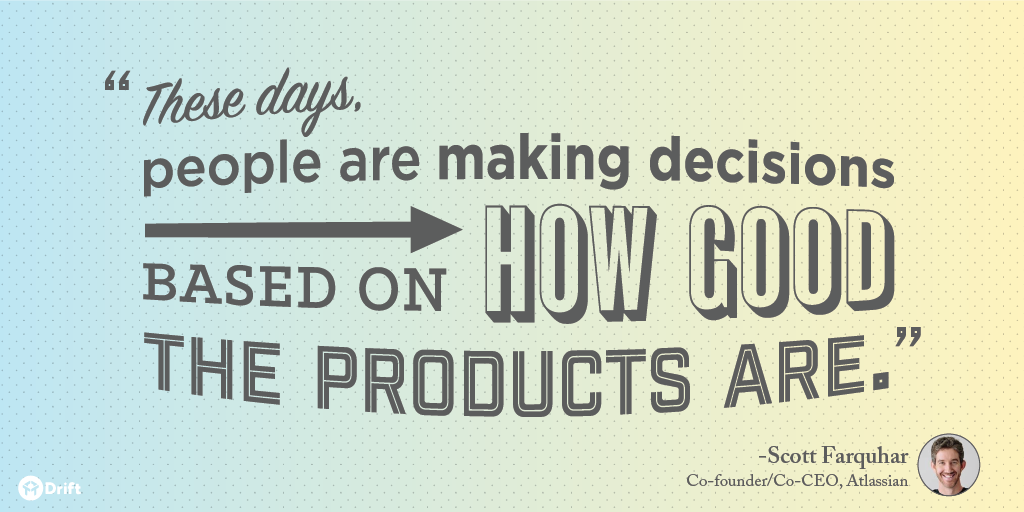
"Fifteen years ago, every bit long every bit you had the best distribution you would win. It didn't matter whether Oracle was worse than SAP. These days, people are making decisions based on how expert the products are."
With the freemium model, the goal isn't to generate and nurture leads, it's to drive product sign-ups. And so instead of convincing people that they could do good from your production, with freemium you're putting the product directly into their easily so they can benefit from it.
Or at least that's the thought.
If people don't terminate up liking your product, they'll stop using it. If they practise like information technology, they'll keep using it (and — ideally — tell their friends and coworkers nearly it).
In marketing jargon terms, nosotros'd phone call the folks in this latter grouping product-qualified leads (PQLs). They're the people who y'all think would be a good fit for a paid version of your product based on the fact that they've already used and derived value from your free product. And different marketing-qualified leads (MQLs), and sales-qualified leads (SQLs), PQLs are depression-touch: Yous don't demand someone reaching out to them (or bombarding them) with demos, trials, or other bottom-of-the-funnel offers.
As a result, the freemium model tin remove a footstep from the traditional procedure of product adoption, as people can go directly from considering your product to using information technology for free — no filling out lengthy forms, no entering credit card numbers, and no talking to sales reps. A proper name and an email address are usually all that a person needs to become started.
After that, it'southward up to the user if her or she wants to pay for an upgrade, but at that place'south no requirement to do so.
For all you visual learners out there, hither's what the freemium model looks similar in concern-school-slide format (via MIT OpenCourseWare).
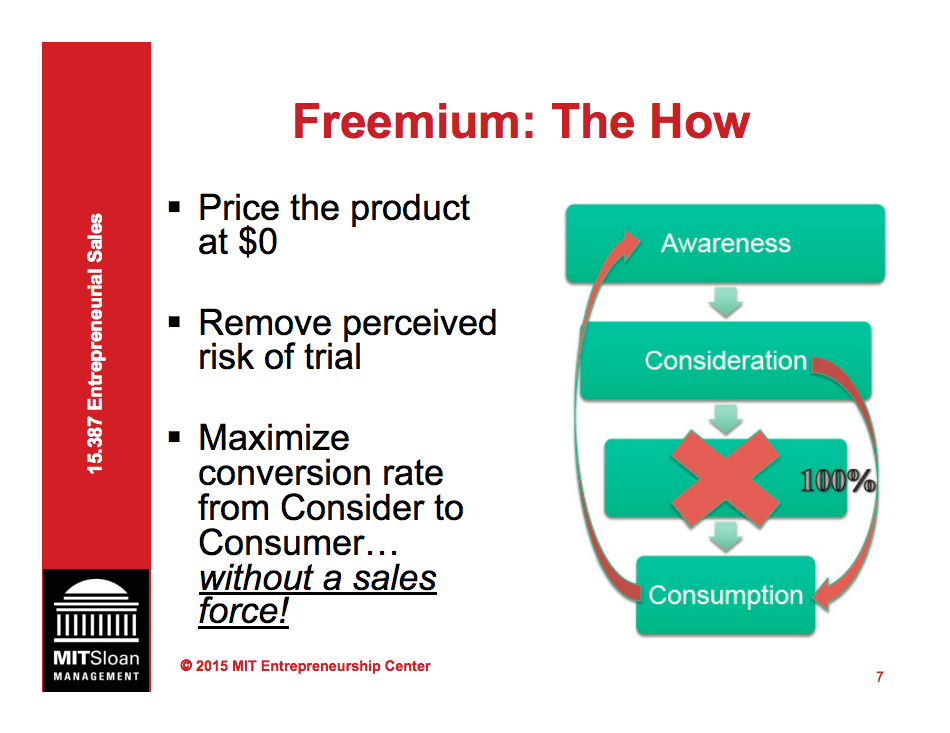
Find that terminal bullet point, which is underlined, italicized, and given an assertion point: "without a sales force!"
It almost sounds too good to be true.
And, arguably, information technology is.
Office ii: Why Freemium Nonetheless Needs Sales
I recently wrote an commodity near Slack's growth strategy and how the visitor earned a billion-dollar valuation without a traditional sales force.
At the end of that story, however, I besides mentioned that nowadays, Slack does have a sales forcefulness on the payroll. To quote a March 2022 tweet from Slack's CEO: "We take lots of salespeople and are hiring more!"
Then, why did Slack end upwardly altering its successful, sales-less approach to selling, an approach that helped them become ane of the fastest-growing companies of all time?
The consensus seems to exist that afterwards rapidly saturating the small business/startup market, Slack needed to bring on sales reps to help them tap the enterprise marketplace. And based on the conversations I had with Codeship'southward VP of Sales, Jack Drew, and Onshape's Managing director of Inside Sales, Chris Essler, this is a anticipated trajectory for successful SaaS companies looking to grow beyond what they've been able to accomplish with freemium alone.
Here's Jack:
This is the fourth SaaS startup that I've been a part of that has freemium in the model in some way. And also iii out of those four had an ecomm channel as well …You can build a really good business organisation utilizing an ecomm channel and non having a sales organisation. Nevertheless, somewhen you reach a signal of plateauing. Yous also reach a stage in the evolution of the business organisation where it necessitates bigger acquirement leaps, and you can't every bit easily or effectively reach bigger jumps in revenue generation, velocity and scale unless you invest in building a globe-class sales squad. Leveraging both channels is ideal. Allow smaller deals to sheet-through ecomm and the human interaction with sales to maximize ASP (average selling cost).
And here'due south Chris:
Whether information technology's freemium or not, the fact of the matter is that if you plan on competing with an enterprise product at any level or organization above a B2C-type sell, you're going to need a sales team.
Jack and Chris aren't alone in their thinking.
In a 2022 article in Business Insider, Jason Lemkin of Storm Ventures laid out some numbers. He said that based on a freemium visitor earning $10 per paid user/per month, with a conversion rate of 2% (which he cited as an industry average), that company would need fifty million gratis users in order to reach $100 1000000 in annual sales.
"We'd all love to do freemium considering we don't have to rent salespeople," Lemkin said, "but … there just aren't plenty businesses in the unabridged globe to go to a $100 million business at freemium."
Every bit a result, he argues, almost freemium companies will inevitably need to install a sales function as they head off to enterprise-land in search of larger deals.
And hiring a sales force at this phase in a freemium company's growth makes a lot of sense. Because the folks who are responsible for purchasing software for organizations with thousands or tens of thousands employees aren't probable to utilise the self-checkout widget on your pricing page. They're prooobably going to want to talk to a human who can answer questions and explain the production inside and out. From a customer success perspective, having such a human on staff seems like a reasonable idea.
Here's how Chris explained information technology:
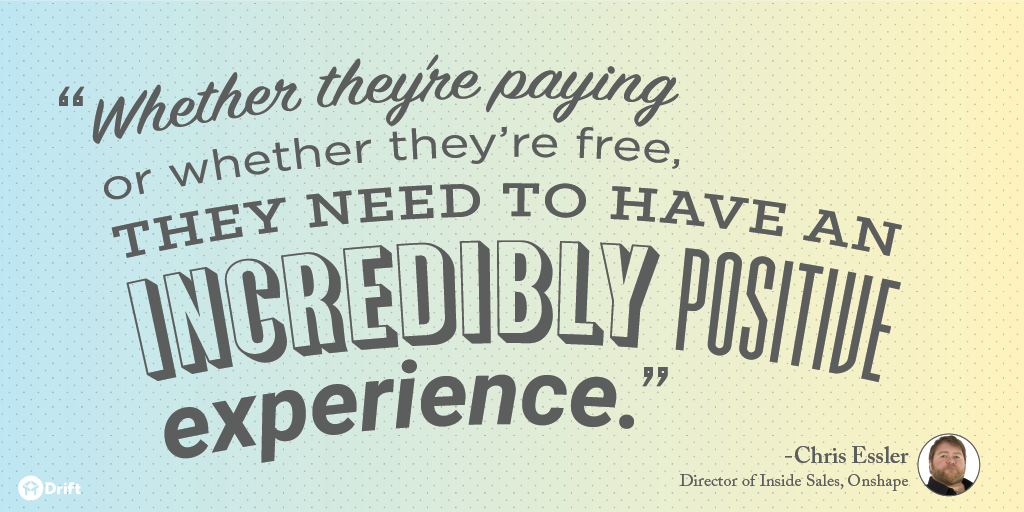
Our goal is to brand our customers successful. Whether they're paying or whether they're gratuitous, they need to take an incredibly positive experience with the arrangement, and with the product, and office of that experience for a lot of larger customers needs to exist an account managing director or a salesperson or an business relationship executive or someone who can get on the phone and take a level of interaction.
That'southward non to say, however, that sales reps are exclusive to freemium companies that have started targeting the enterprise. Any freemium company at whatever stage tin benefit from having experienced salespeople on staff.
In comparing to a more than traditional sales operation, however, the function of sales in a freemium environment tin sometimes be quite different.
In Drift'southward new ebook, How Sales Has Changed , we talked most how with freemium companies, "… it becomes sales' task to differentiate one free customer from another to effigy out who to spend time with."
Jack from Codeship refers to this practise equally "mining the customer base." And for Codeship it entails using sales tools that can help "getting the product data out of the back-stop of Codeship and pipage that into Salesforce so that we can become really sophisticated around who are the most engaged free subscribers."
From in that location, the Codeship sales team organizes complimentary users into different clusters based on their varying levels of date. Sales reps tin can then achieve out to specific clusters with targeted production offerings.
LinkedIn is another example of a company that does this: They identify clusters of free users and target up-sells toward them. Every bit LinkedIn'southward VP of Enterprise Business organisation Development, Scott Roberts, told Inc. back in 2022:
Less than one% of members pay u.s.a.. We leverage the data from the free power users, and await for clusters of activity. Then we build a marketing and functionality focus around the clusters. That is one of the ways that we got started on [LinkedIn's valuable] recruiting products.
And here's Roger Lee also explaining how the "clusters" technique tin work, this time in regards to selling into the enterprise:
Salespeople simply await for clusters of agile users of the freemium product in an enterprise account; those customers are likely getting value, so they're adept candidates for an upwardly-sell.
These practices, mining the customer base and identifying clusters, are cardinal to freemium sales. And they assist give sales reps a well-defined purpose inside a freemium organization. Instead of being responsible for bringing in new buyers, freemium sales reps can exist responsible for matching active users with the version of the product that will yield those users the most value — even if that means recommending they stick with the costless version.
As Assist Scout's Caput of Sales, Tim Thyne, told me, today's sales reps demand to "approach conversations with the mindset of 'what's best for this customer' over 'how much money volition I make/lose if they come onboard or not.'"
Because in the long run, a positive interaction tin can outweigh the value of a forced auction.
Or, every bit Tim phrased information technology:
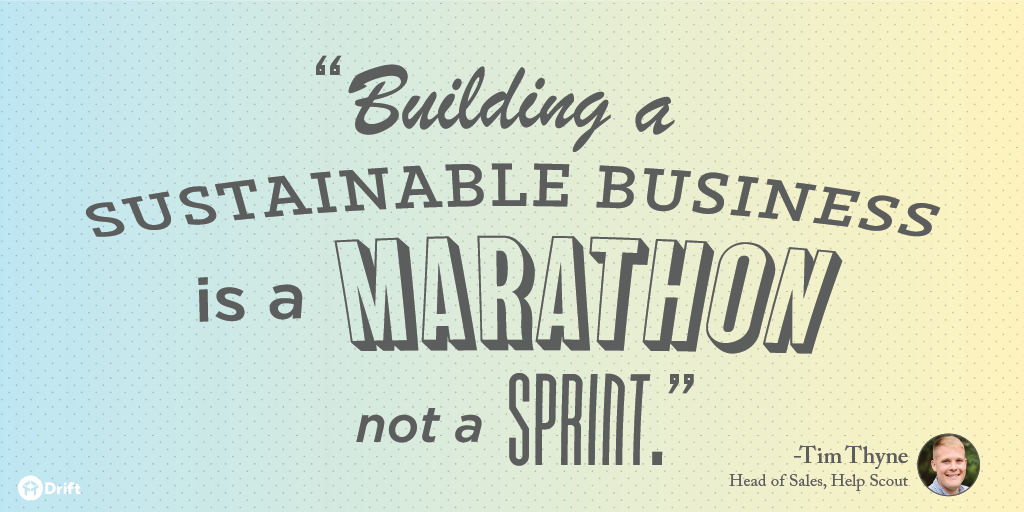
Building a sustainable business organization is a marathon, not a sprint — even if we don't close a customer today; if we provide them a stellar experience then it'due south likely they recommend usa or come back again in the future.
At this point, I think we can safely conclude that sales reps can (and do) have plenty of purpose within freemium companies.
From engaging enterprise prospects, to mining client data and identifying clusters, it'south clear that freemium sales reps can deliver real value. And in a way, the value that sales reps deliver is part of what customers are signing up for.
As Chris explained:
If you think about it, the technology is just one-half of what a company is truly buying in this day and age. They're also vetting, "What's the back up model like? What'due south the vision of the company? What'due south the brand? How consequent is this arrangement going to be as far as new feature releases?" And that's actually what the sales team does. Your sales team is essentially a manifestation of the brand and visitor you're trying to build.
Office three: How to Motivate (and Compensate) Freemium Sales Reps
For someone with traditional sales experience, joining a sales force that has a freemium product can potentially be a bit of jolt. Some reps might even go into it thinking that it's going to be easier than what they're used to (after all, the folks they're selling to are already using the product).
Hither's Tim'due south take on the state of affairs:
I wouldn't say the more "traditional" sales rep views their role as less valuable because they are selling into a more qualified pool of leads (people using costless product) — they love qualified leads. However, information technology does seem as though they don't assume it will be as big of a challenge as what they're apply to, which is not true. ?
(Editor'southward note: That emoji is absolutely function of the quote.)
For Tim, the keys to motivating his sales squad at Help Lookout man include focusing on the client, encouraging teamwork, and, of course, offering competitive salaries.
Not included on that listing? Paying commission based on deals airtight.
As Tim explained:
We enable you to practise your best work, stay focused on the client, and pay competitively. Although it's not commission, it'due south equivalent and in a lot of cases a higher base salary than your OTE (on-target earnings) would exist in "traditional" sales. All we enquire is that y'all exercise what's best for the customers and our philosophy is if we we exercise that, nosotros'll win.
Tim also highlighted iii benefits of forgoing commission-based sales bounty:
- Pb assignment is much easier and in that location isn't conflict around who gets assigned what.
- Team members can loop in or pass off a bargain to a teammate with more domain expertise if necessary and not worry about losing/sharing commission.
- It's very operationally efficient.
To be sure, Help Picket isn't the merely company that's found value in canning commission. In fact, some companies — like Slack — promote the fact that they have a commission-free sales model about as if it'southward an added feature.
Equally Slack'south pricing folio notes:
No one at Slack works on commission, so you don't have to worry most anyone selling you on a pricing plan you don't need. We're merely hither to aid you have the best feel possible.
That doesn't hateful, even so, that all successful freemium companies forgo commission, or that companies that exercise pay commission provide crappier customer experiences by default. Due to the nuanced nature of freemium (and business in general), it's innacurate to paint with such wide strokes.
Have Codeship's sales model, for example. As Jack explained to me:
[Codeship] sales reps build their ain book of business and they retain those customers. As such, even if they close them for a pocket-size dollar amount, which would still be college than ecomm deals, that goes into their book of business. And then, again, it's all nearly establishing the path to larger dollars. In many cases, that path is by way of getting them to sign upward equally a client, fostering engagement with the product,and allowing the product to evangelize value.
From there, our pricing model is structured in such a way that our path to the bigger deals is really "land and expand." It'southward all about getting them in the door and establishing a connexion with our trusted advisor sales reps. A majority of our big customers start smaller and then motion to a more substantial investment.

At present, you could read this and think: "See, by assigning commissioned sales reps to specific accounts, yous're incentivizing those reps to upsell similar crazy … that'south bad!"
But you could also argue that Codeship's land and aggrandize model actually incentivizes sales reps to develop stronger relationships with their customers, since reps are responsible for the success of specific customers throughout the entire client lifecycle. If reps tried to strength their customers into unnecessary upsells, those relationships could become damaged, and reps might gamble losing the unabridged business as a upshot. Hence, reps have an incentive to e'er deliver an astonishing feel — even if their underlying goal is expansion.
The debate over whether or not companies should pay sales reps committee continues to be a healthy one. At the extremes, the arguments for and against it unremarkably pause down something like this:
If you're for commission, you're for a hungry, competitive sales force that can consistently hit and exceed monthly, quarterly, and yearly revenue goals. You lot view a commission-costless sales model as, at best, slow, and at worst, a Kumbaya circle where no ane has whatever bulldoze and zippo gets done.
If you're against commission, on the other hand, y'all're for a sales strength that puts the client's needs alee of revenue goals, and that values collaboration over competition. Y'all view the traditional, committee-based sales model equally, at best, a brusk-term revenue solution, and at worst, a barbaric institution that leads to negative customer experiences and, later, churn.
Of form, the reality of the situation isn't so black and white. In some cases, committee might be exactly what's needed to energize a freemium sales team. In other cases, commission-free might be the way to go. The bounty model that works best for your sales organization will depend on your own unique set of circumstances, including your industry, your target market place, also as the specific flavor of "freemium" your company decides to apply.
That being said, I'd hate to go out you lot with one of those then-in-conclusion-everything-is-really-complicated-and-there's-no-articulate-respond-here endings. Then instead of doing that, I'll brand this closing announcement:
Regardless of the sales compensation model you go with, one of the best things you lot tin exercise equally a freemium company in order to motivate sales reps is to build an amazing product. If you lot build a production that people love, a product that'south able to go initial traction based on positive user experiences and word of oral cavity, your sales reps will feed off that energy.
Best of all, it'due south a virtuous cycle: Your amazing production attracts new users and, even if they don't become paying customers, sales reps tin can learn from their behaviors and glean insights for making the product, every bit well as the sales process, even meliorate.
To quote Chris from Onshape:
When you think most what grows a company, it's not acquirement at first. It'southward successful customers. It's getting people to purchase into the vision … Revenue will come. If y'all have built the correct product, for the correct marketplace, revenue will come. But what can't come soon enough is adoption. Because adoption lets us understand usage, and information technology lets us understand how nosotros want to continue to abound and what direction we desire to take the product, and what direction we desire to have our marketing and sales efforts.
Ultimately, the product is the foundation on which all aspects of a freemium business stand. Take that abroad, and even the best sales reps in the world won't be able to find success.
It's like Chris told me:
Building a sales squad to go out and conquer the world is easy: We hire someone like me, nosotros hire a couple of other senior people, and we build the empire. Only you lot tin't be going out there trying to build an empire on tooth picks and promises.
Curious nearly Drift? Click hither to learn more about what nosotros've congenital for sales and marketing.

Source: https://www.drift.com/blog/how-sales-reps-make-money-selling-free/
Posted by: morrisgonstornes.blogspot.com
0 Response to "How Much Money Do Wine Sales Reps Make"
Post a Comment